How to Memorise the Guitar Fretboard (Complete Guide) | Alien Guitar Secrets
 Rob Lobasso

Learn how to memorise the guitar fretboard using octave patterns, note relationships, and simple practice methods used by professional guitar teachers
How to Memorise the Guitar Fretboard
Many guitarists spend years learning songs, scales and chords, yet still feel lost when navigating the fretboard. They rely on patterns and shapes rather than truly understanding where the notes exist across the neck.
Without a clear mental map of the guitar fretboard, playing often becomes guesswork. You may know a scale pattern, but when it comes to improvising, constructing melodies or understanding harmony, the instrument still feels confusing.
Fretboard mastery begins with knowing where the notes are located.
Once you understand the relationships between notes across the guitar neck, the instrument begins to make sense as a complete musical system rather than a collection of disconnected shapes.
👉 Take Your Fretboard Knowledge Further
Why Learning the Notes Matters
Many players stay stuck in the first few frets of the guitar simply because they never learn where notes exist beyond those areas.
But the guitar is unique among instruments because the same note appears in multiple locations across the fretboard.
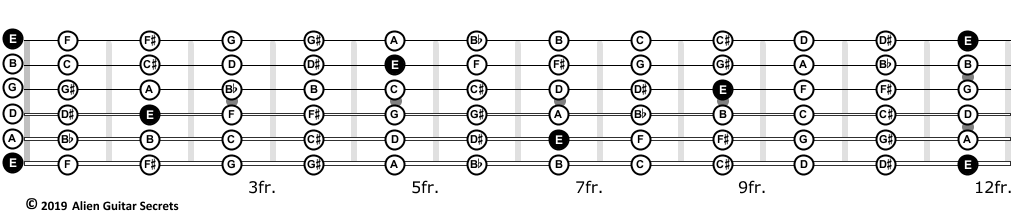
This means every chord, melody and scale can be played in several different positions.
When you understand the fretboard fully, you gain:
• more melodic options
• greater chord flexibility
• smoother improvisation
• deeper musical awareness
Instead of reacting to patterns, you begin thinking in notes and musical relationships.
Understanding the Structure of the Fretboard
The guitar fretboard follows a simple principle.
Every fret represents one semitone of movement.
Moving one fret higher raises the pitch by one semitone. Moving one fret lower decreases the pitch by one semitone.
👉 Explore the Alien Guitar Secrets Fretboard Mastery Course
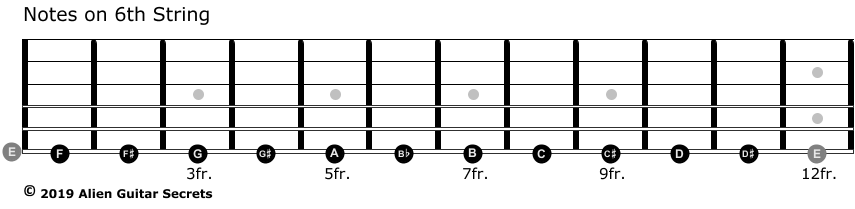
Standard guitar tuning is:
E – A – D – G – B – E
Most strings are tuned in perfect fourths except for the relationship between the G and B strings, which creates a slight adjustment in note patterns across the fretboard.
Understanding this tuning relationship helps explain why note patterns repeat across the neck.
The Octave System
One of the fastest ways to memorise the fretboard is by understanding octave relationships.
An octave is the same note repeated at a higher or lower pitch.
For example:
C → C
E → E
A → A
On the guitar, octave relationships follow predictable patterns.
Once you learn these patterns, you can locate the same note across the entire fretboard very quickly.
This becomes the foundation for memorising the guitar neck.
👉 Explore the Alien Guitar Secrets Fretboard Mastery Course
A Simple Practice Method
The best way to memorise the fretboard is through consistent daily practice.
Choose one note each day and locate it across the entire guitar neck.
For example:
Find every C on the fretboard.
Then repeat the exercise with:
D
E
F
G
A
B
Use a metronome and gradually increase your speed as your recognition improves.
Over time, this process builds a strong mental map of the instrument.
Integrating Fretboard Knowledge Into Your Playing
Memorising the notes is only the first step.
The real goal is integrating this knowledge into your playing.
You can do this by:
• naming notes while practising scales
• identifying chord tones
• singing note names while playing
• visualising intervals when improvising
These exercises connect theoretical knowledge with real musical expression.
Next Step: Fretboard Mastery
If you'd like a clear step-by-step system for mastering the guitar fretboard, including notes, intervals, scales, chords and improvisation across the entire neck, explore the Alien Guitar Secrets Fretboard Mastery Course.
This course expands on the concepts in this guide and shows you exactly how to connect the entire guitar neck into one integrated musical system.
👉 Explore the Alien Guitar Secrets Fretboard Mastery Course
Continue Learning
- Octave Shapes Every Guitarist Should Know
- The Best Way To Practice The Guitar Fretboard
- Why Guitarists Feel Lost on the Fretboard
- How To Memorise The Guitar Fretboard
- The Guitar Fretboard Notes Explained
- Guitar Intervals Explained
- The 5 Formulas That Unlock The Guitar Fretboard
- How To Find Any Note On The Guitar Fretboard
Categories: : fretboard logic, fretboard navigation